Monday, January 25, 2016

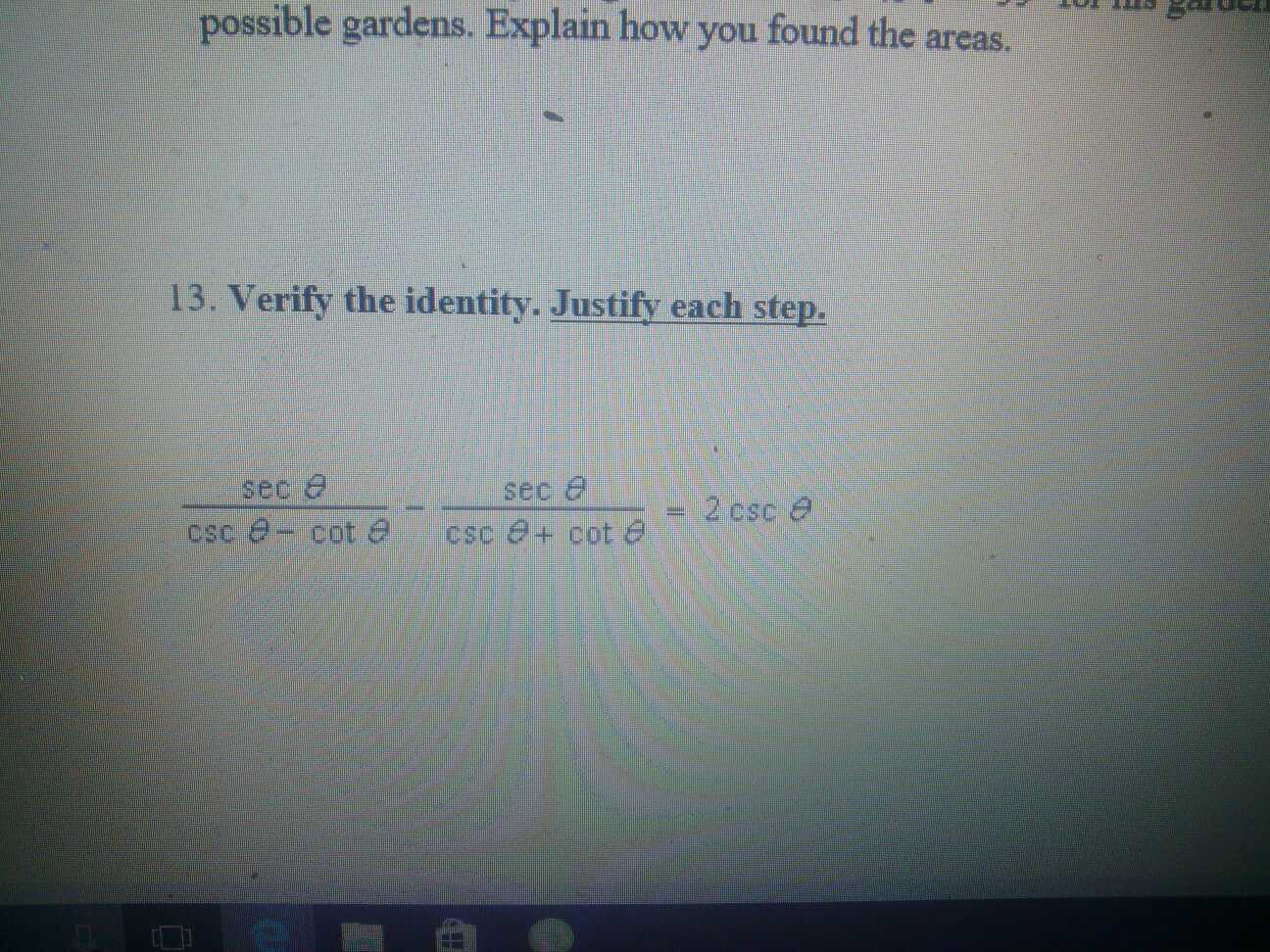
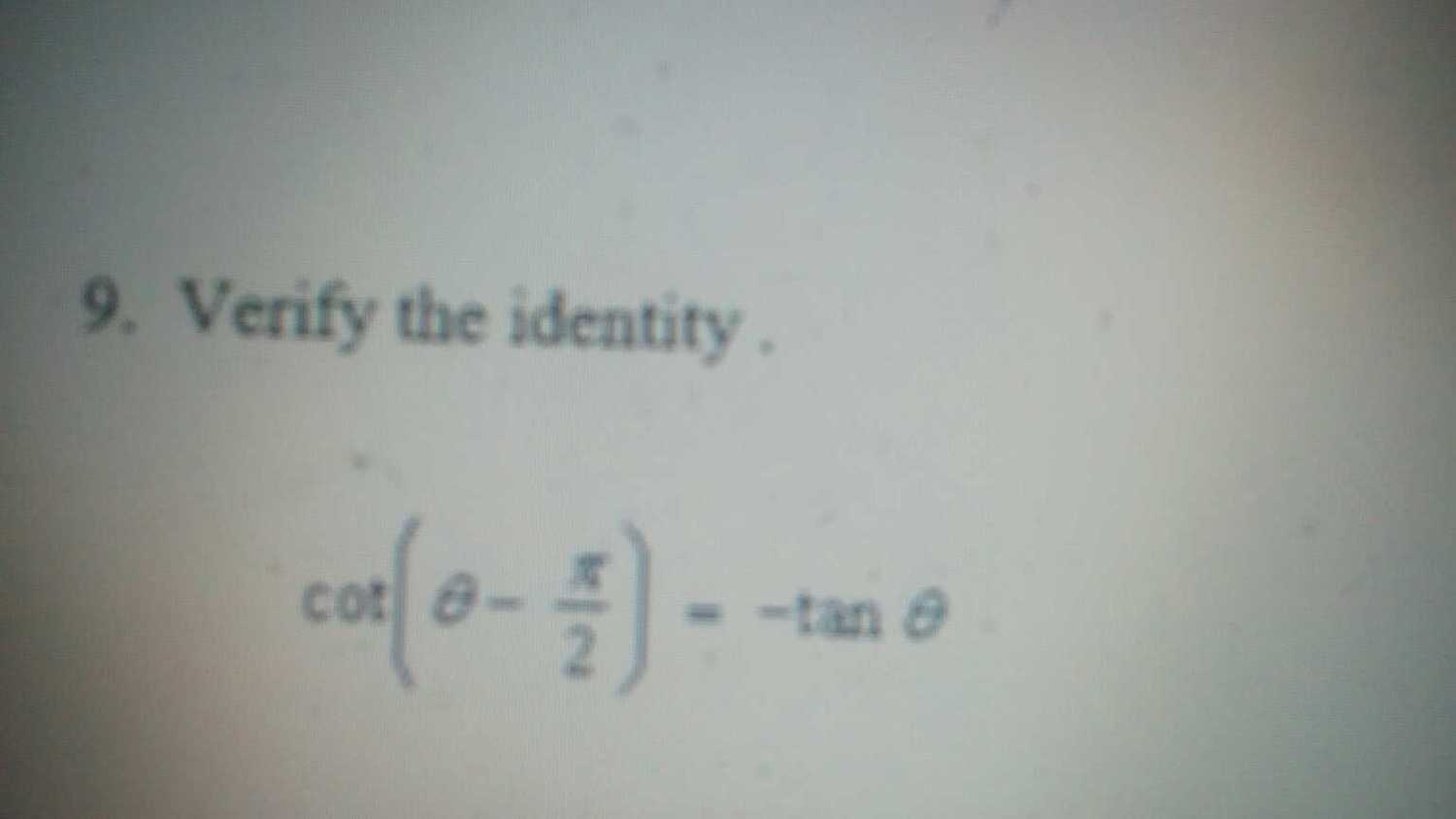
Verify the identity

Problem:


Solution:

$ \cot(\theta - \frac{\pi}{2}) $

By definition of cotangent, we have

$ = \frac{\cos(\theta - \frac{\pi}{2})}{\sin(\theta - \frac{\pi}{2})} $

By phase shift formulas, we have

$ = \frac{\sin(\theta)}{-\cos(\theta)} $

By definition of tangent, we finally get

$ = -\tan(\theta) $

Thursday, January 21, 2016

Trigonometry problem

Problem:


Solution;

$ \frac{\sec \theta}{\csc \theta - \cot \theta} - \frac{\sec \theta}{\csc \theta + \cot \theta} $

Multiply $ \sin \theta \cos \theta $ above and below:

$ \frac{\sin \theta}{\cos \theta - \cos^2 \theta} - \frac{\sin \theta}{\cos \theta + \cos^2 \theta} $

Make common denominator gives:

$ \frac{\sin \theta(\cos \theta + \cos^2 \theta)}{(\cos \theta + \cos^2 \theta)(\cos \theta - \cos^2 \theta)} - \frac{\sin \theta(\cos \theta - \cos^2 \theta)}{(\cos \theta + \cos^2 \theta)(\cos \theta - \cos^2 \theta)} $

Now do the subtraction

$ \frac{\sin \theta(\cos \theta + \cos^2 \theta)-\sin \theta(\cos \theta - \cos^2 \theta)}{(\cos \theta + \cos^2 \theta)(\cos \theta - \cos^2 \theta)} $

Simplify the numerator by just expand and subtract:

$ \frac{2\sin \theta\cos^2 \theta}{(\cos \theta + \cos^2 \theta)(\cos \theta - \cos^2 \theta)} $

Simplify the denominator:

$ \frac{2\sin \theta\cos^2 \theta}{\cos^2 \theta(1 + \cos \theta)(1 - \cos \theta)} $

Cancel the $ \cos^2 \theta $:

$ \frac{2\sin \theta}{ (1 + \cos \theta)(1 - \cos \theta)} $

Expand the denominator:

$ \frac{2\sin \theta}{1  - \cos^2 \theta} $

Just an identity

$ \frac{2\sin \theta}{\sin^2 \theta} $

There we go

$ 2 \csc \theta $

Sunday, January 10, 2016

Shift

Problem:


Solution:

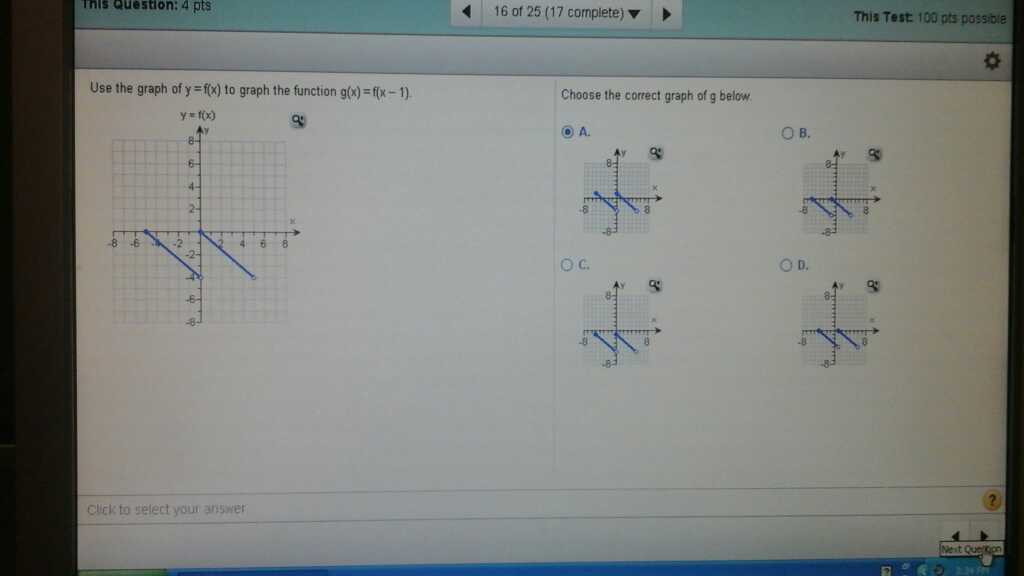
We simply check $ g(0) = f(-1) = -3 $.
So we pick the answer to be D.

Inverse

Problem:


Solution:

Part (a)
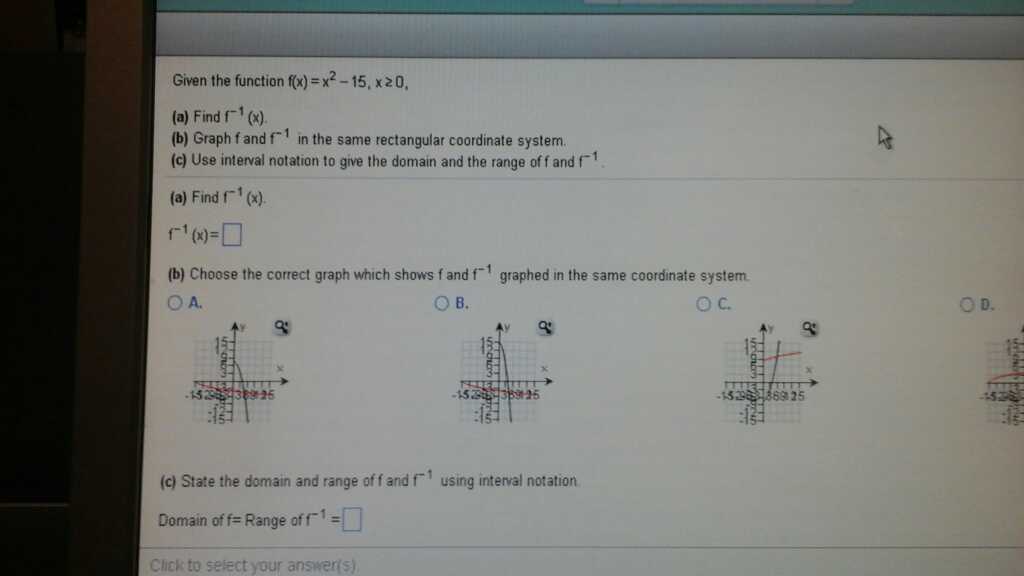
$ f^{-1}(x) = \sqrt{15 + x} $

Part (b)

Part (c)

The domain of $ f $ = Range of $ f^{-1} $ = $ [0, +\infty) $.
The range of $ f $ = domain of $ f^{-1} $ = $ [-15, +\infty) $.

Tuesday, December 15, 2015

Soluability constant

Problem:


Solution:

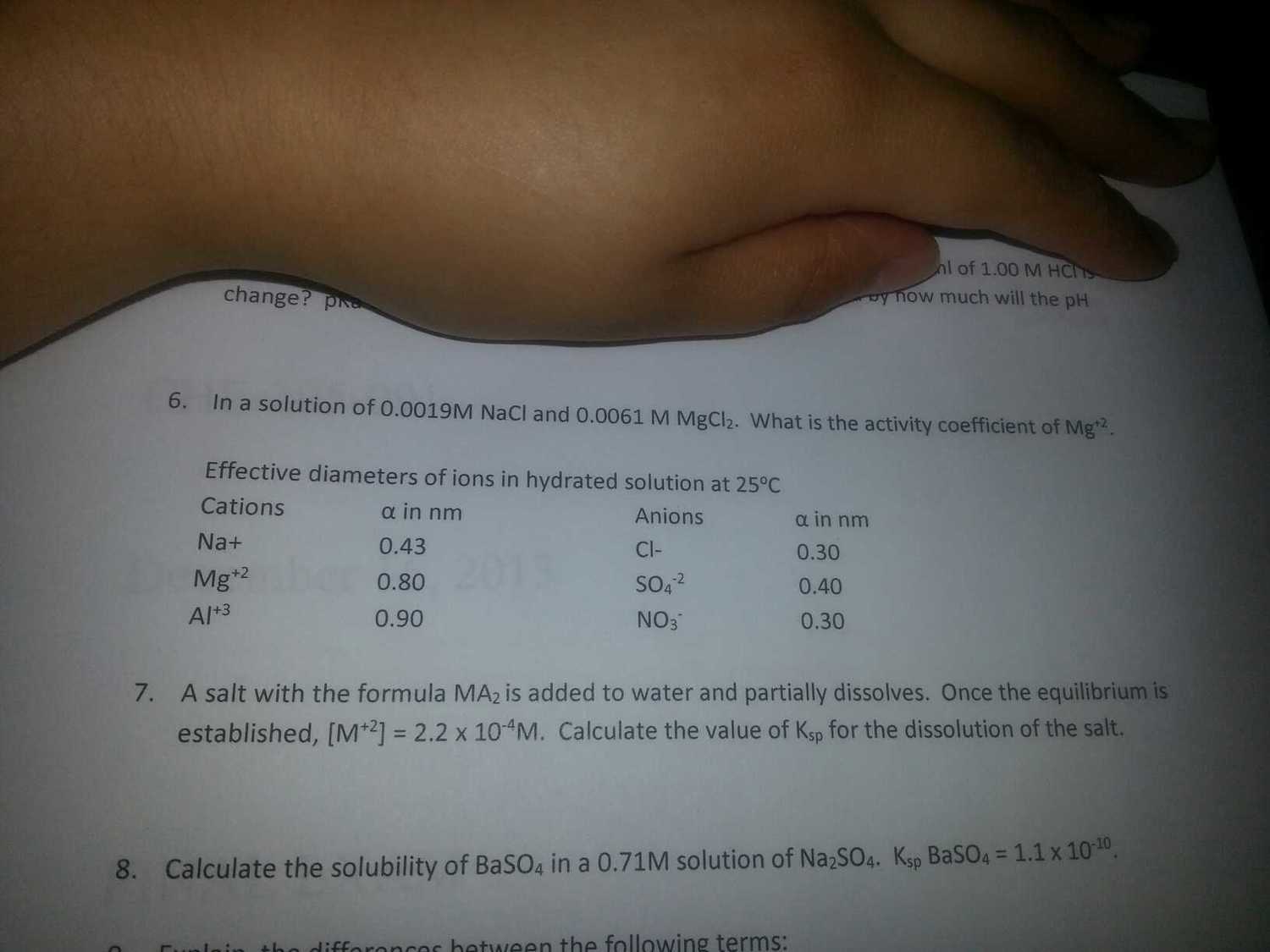
By the chemical formula, for every cation, we have two anion.

$ [A^-] = 2.2 \times 10^{-4} \times 2 = 4.4 \times 10^{-4} $

Therefore the solubility product $ K_{sp} = [M^{+2}][A^{-1}] = 2.2 \times 10^{-4} \times 4.4 \times 10^{-4} = 9.68 \times 10^{-8} $

Sunday, December 13, 2015

Acid dissociation constant

Problem:


Solution:

Let's determine what are the chemicals first.

$ CH_3CO_2H $ is acetic acid, it is a weak acid in aqueous solution.

$ NaCH_3CO_2 $ is sodium acetate, it is a salt.

$ HCl $ is hydrochloric acid, of course.

First of all, we have 100 mL = 0.1 L of the buffer solution, so we have

$ 0.2 \times 0.1 = 0.02 $ mol of $ CH_3CO_2H $ and
$ 0.34 \times 0.1 = 0.034 $ mol of $ NaCH_3CO_2 $.

The salt is an ionic compound, so it dissolves in water and become $ Na^+ $ and $ CH_3CO^-_2 $

The fact that acetic acid is a weak acid means we need to compute how well it dissociate in water using the constant, in particular, we have these two equations

$ pK_a = -\log K_a $
$ K_a = \frac{[A^-][H^+]}{[HA]} $

With the first formula, we can solve for $ K_a = 10^{-4.74} $.

Now we have the reversible reaction:

$ CH_3COOH \to  CH_3COO^- + H^+ $, let say, out of 0.02 mol of $ CH_3COOH $, $ p $ mol of them got dissociated, so we get the total number of moles of elements as:

$ \begin{eqnarray*} [CH_3COOH] &=& 0.02 - p \\ [CH_3COO^-] &=& p + 0.034 \\ [H^+] &=& p \\ [Na^+] &=& 0.034 \end{eqnarray*} $

Plug these values into the $ K_a $ formula, we can solve for $ p $ as follow:

$ 10^{-4.74} = \frac{(p + 0.034)(p)}{0.02-p} $

The resulting quadratic formula has two roots, rejecting the obviously wrong negative solution, we have solved $ p = 1.0695 \times 10^{-5} $.

So the pH value is $ -\log p = 4.97 $.

Now we add hydrochloric acid. We added 8ml = 0.008L of 1M $ HCl $, so we have added $ 0.008 \times 1 = 0.008 $ mol of $ HCl $.

Hydrochloric acid is a strong acid and we assume it completely dissociate (not completely true, but a good approximation), so the number of moles changes as follow:

$ \begin{eqnarray*} [CH_3COOH] &=& 0.02 - p \\ [CH_3COO^-] &=& p + 0.034 \\ [H^+] &=& p + 0.008 \\ [Na^+] &=& 0.034 \\ [Cl^-] &=& 0.008 \\ \end{eqnarray*} $

Now we solve the $ pK_a $ formula again and get $ 10^{-4.74} = \frac{(p + 0.034)(p + 0.008)}{0.02-p} $, but wait, the formula only generate negative $ p $. Now, what does it mean? It means instead of dissociating, the acetate ions take the proton and form the acid instead! In this case, we have $ p = -0.00798 $ and therefore the proton concentration is $ -0.00798 + 0.008 = 1.95684 \times 10^{-5} $, so the pH is $ -\log (p + 0.008) = 4.71 $.

As expected, it becomes more acidic!
Wednesday, December 2, 2015

How many atoms?

Problem:

Find the number of particles in 15.4g of sodium when one mole has the mass of 23g

Solution:

One mole has mass 23g
15.4g has $\frac{15.4}{23} $ mole
One mole has $ 6.022 \times 10^23 $ atoms.
So we have $ \frac{15.4}{23} \times 6.022 \times 10^23 = 4.032 \times 10^23 $ atoms.